Author name: ashifkaofficial@gmail.com

trading journal
Risk Management

Trading Journal: 7 Best Easy Steps to Start One

Ask a few traders what helped them improve the most, and many will say the same boring thing: a trading journal. No fancy indicator, no secret strategy. Just a notebook or a sheet where they wrote down every trade. It sounds too simple to matter, but it is probably the cheapest way to get better at trading. Here is how to start a trading journal, what to write in it and how to actually keep going with it. What Is a Trading Journal? A trading journal is a record of every trade you take. You note why you entered, where your stop loss was, how the trade ended and what you were thinking at the time. That’s it. It is not a diary and it does not need to look nice. It only needs to be honest. Why You Need a Trading Journal Most of us forget our trades within a week. We remember the big wins and we conveniently forget the silly losses. Without a record, you keep repeating the same mistakes and you never notice it. A trading journal shows you the truth in black and white. Maybe you lose most of your money on Mondays. Maybe you break your own rules after two wins in a row. You can’t fix a pattern you can’t see. It also helps with the emotional side. When you have to write down “I entered because I was bored,” you think twice before doing it again. If you want to read more on that, we wrote about trading psychology separately. What to Write in Your Trading Journal Keep it simple. If the journal feels like homework, you will quit in a week. These are the basics: That last point matters more than it looks. A one line lesson after every trade adds up to something powerful after a month. Step 1: Choose Your Format Use whatever you will actually open every day. A paper notebook works fine. So does Excel or Google Sheets. There are apps too, but a simple sheet is enough when you are starting. Don’t spend three days finding the perfect tool, just begin. Step 2: Write the Plan Before the Trade Fill in the entry, stop loss and target before you click buy or sell. This one habit stops a lot of impulsive trades, because writing it down forces you to think. If you can’t explain the setup in one line, you probably shouldn’t take it. Your plan should also respect your risk rules, so read our guide on risk management in trading if you haven’t set those yet. Step 3: Add a Screenshot Take a screenshot of the chart at entry and another at exit. Words alone are not enough. Months later, a chart image tells you exactly what you saw that day. It is also great for spotting whether your candlestick patterns and support and resistance levels were really as clean as you thought. Step 4: Record the Result Honestly Write the real number, even if it hurts. Also note whether you followed your plan. A trade can be a win and still a bad trade, for example when you ignored your stop loss and got lucky. Mark those separately. A good trade follows the plan. The result is secondary. Step 5: Note Your Emotions Your trading journal should say how you felt too. Were you calm, anxious, excited, angry? Be blunt. After a few weeks you may notice that your worst trades all happen when you are rushed or frustrated. That is gold. It tells you when to stay away from the screen. Step 6: Review Every Week Writing in your trading journal is only half the job. Once a week, maybe on Sunday, sit down and read your last five to ten trades. Look for repeats. Which setup worked? Which mistake showed up again? Pick one thing to improve next week, just one. Step 7: Check Your Numbers Every Month At the end of the month, count your trades, your win rate and your average reward compared to your average risk. You do not need advanced maths. Even basic numbers will show whether your strategy is working or whether you are only feeling good about it. This is also where a stop loss in trading earns its place, because you can see how much it saved you. Common Trading Journal Mistakes People usually fail with a journal in a few predictable ways. They make it too complicated and quit. They only record winning trades. They write the entry after the trade is already closed. Or they write everything down and then never read it again. If you avoid these four, you are already ahead of most beginners. A Small Tip If You Are New If you haven’t placed a real trade yet, start your journal on a demo account. You get the habit without risking money. When you are ready for live trading, check our guide on how to start share market and keep the same journal going. Questions People Ask Do I really need a trading journal if I am just practising?Yes. Practice trades teach you the most when you review them. Otherwise it is just clicking buttons. How long should I keep a journal?For as long as you trade. Many experienced traders still keep one. Excel or notebook, which is better?Whichever you will use daily. Excel makes monthly numbers easier, a notebook is faster for notes. How many details are too many?If filling it takes more than two or three minutes per trade, cut some fields. Final Words A trading journal will not make you rich overnight, and nobody can promise you profits. What it does is make you honest with yourself, and that is where improvement starts. Start small, write after every trade and read it every week. In a month or two you will know your own trading better than any course can teach you. If you want to learn trading step by step with guidance, join ELY8FX, one

intraday vs swing trading
Trading Basics

Intraday vs Swing Trading: 5 Best Easy Differences

Intraday vs swing trading is one of the first questions every new trader asks. Both styles try to profit from price movements, but they are very different in time, risk and effort. Intraday trading means buying and selling within the same day, while swing trading means holding a trade for a few days or weeks. In this guide on intraday vs swing trading, you will learn how each style works, the key differences and how to choose the right one for you. What Is Intraday Trading? Intraday trading means you open and close your trades on the same trading day. You do not carry any position overnight. In the Indian share market, intraday positions are usually squared off before the market closes. Intraday traders look at short timeframes such as the 1-minute, 5-minute and 15-minute charts, and they aim to profit from small price moves during the day. What Is Swing Trading? Swing trading means holding a trade for several days or a few weeks to capture a bigger price move, or a swing. Swing traders use higher timeframes such as the 4-hour and daily charts. They do not need to watch the screen all day, because they check the market once or twice a day and place orders with a stop loss and a target. Intraday vs Swing Trading: 5 Key Differences Here is how the two styles compare in simple terms. Difference 1: Holding Time Intraday trades last from a few minutes to a few hours and always close the same day. Swing trades last from two days to a few weeks. This single difference affects almost everything else in the intraday vs swing trading comparison. Difference 2: Time and Screen Commitment Intraday trading needs your full attention during market hours, because prices change fast. Swing trading needs far less screen time. If you have a job or a business, swing trading usually fits better into your day. Difference 3: Risk and Stress Intraday trading can be stressful, because decisions must be quick and mistakes happen easily. Swing trading carries overnight risk, which means the price can open far away from where it closed after news or a global event. Neither style is risk free, and both need a stop loss. Difference 4: Charts and Tools In intraday vs swing trading, the tools also differ. Intraday traders use short timeframes and quick signals. Swing traders use support and resistance, trend lines and candlestick patterns on daily charts, which are generally cleaner and less noisy. Difference 5: Costs Cost is another part of intraday vs swing trading. Intraday traders place many trades, so brokerage and taxes add up quickly. Swing traders place fewer trades, so costs are usually lower. Always check your broker charges before you decide. Intraday vs Swing Trading: Which Is Better for Beginners? For most beginners, swing trading is easier to start, because it gives you time to think, needs fewer trades and has lower costs. Intraday trading is faster and demands more discipline and experience. The better choice in intraday vs swing trading depends on your time, your capital and your personality. Start with the style that fits your daily routine, and practice on a demo account first. Risk Management Applies to Both Styles Whichever style you pick, protect your capital first. Risk only 1% to 2% of your account on each trade, as explained in our guide on risk management in trading. Always place a stop loss before you enter, and learn the methods in our guide on stop loss in trading. Many traders also struggle with emotions, so read about trading psychology to avoid overtrading and revenge trading. How to Get Started If you are new, first learn the basics in our guide on how to start share market. You will also need an account, so see our guide on demat account opening. Then learn to read charts, start small and keep a journal of every trade. Common Mistakes in Intraday and Swing Trading In intraday vs swing trading, the most common mistakes are trading without a stop loss, risking too much on one trade, taking too many trades, following social media tips without a plan and switching styles after every loss. Pick one style, test it on a demo account and stay consistent for a few months before judging it. Frequently Asked Questions Is intraday or swing trading more profitable?Neither is guaranteed to be profitable. Results depend on your strategy, discipline and risk management, not only the style. Which is better for a beginner, intraday or swing trading?Many beginners find swing trading easier, because it needs less screen time and fewer quick decisions. Can I do intraday and swing trading together?Yes, but beginners should master one style first before mixing them. How much money do I need for intraday vs swing trading?There is no fixed amount. Start with money you can afford to lose and increase only after you show consistent results. Conclusion Intraday vs swing trading is not about which style is better, it is about which style fits you. Intraday needs speed and full attention, while swing trading needs patience and a plan. Whichever you choose, use a stop loss, risk a small amount and practice on a demo account first. If you want to learn trading step by step with expert guidance, join ELY8FX, one of the best trading academy in Kerala options for beginners. Book your free demo class today. Disclaimer: Trading involves risk, and you can lose money. This article is for educational purposes only and is not financial advice.

trading psychology
Trading Basics

Trading Psychology: 7 Best Easy Ways to Control Emotions

Trading psychology is the study of how your emotions and habits affect your trading decisions. Most beginners believe that they lose money because their strategy is bad, but in many cases the real problem is fear, greed and impatience. Good trading psychology helps you follow your plan even when the market makes you nervous. In this guide, you will learn what trading psychology means, the emotions that hurt traders and seven easy ways to control them. What Is Trading Psychology? Trading psychology means the mindset, emotions and behaviour of a trader. It decides whether you wait for a proper setup, whether you accept a small loss calmly and whether you stick to your stop loss. Two traders can use the same strategy and still get very different results, and the difference is usually their psychology. Why Trading Psychology Matters You can learn candlestick patterns and support and resistance in a few weeks, but using them with discipline takes much longer. Strong trading psychology keeps your decisions logical when money is on the line. Without it, even a good strategy fails, because you break your own rules at the worst moments. Common Emotions That Hurt Traders Fear makes you exit a good trade too early or avoid a good setup completely. Greed makes you hold a winning trade for too long or increase your position size without a reason. Hope makes you ignore a stop loss because you think the price will come back. Revenge trading means trading again immediately after a loss to win the money back, and it is one of the fastest ways to blow an account. FOMO, the fear of missing out, makes you jump into a trade just because the price is moving fast. Way 1: Create a Written Trading Plan A written plan removes guesswork. It should say which setups you trade, your entry rules, where your stop loss goes, your target and how much you risk. When the market is moving fast, you simply follow the plan instead of deciding under pressure. Good trading psychology always starts with a clear plan. Way 2: Risk Only a Small Amount Fear grows when the amount at risk is too big. If you risk only 1% to 2% of your account on each trade, a single loss does not hurt emotionally. Read our guide on risk management in trading to learn how to calculate this properly. Way 3: Always Use a Stop Loss A stop loss decides your maximum loss before the trade starts, so you do not have to make a painful decision in the middle of the trade. Learn the methods in our guide on stop loss in trading and set it before every entry. Never move it further away. Way 4: Accept That Losses Are Normal Every trader, even a professional one, has losing trades. A loss is not a failure, it is a cost of doing business. When you accept this, you stop trying to avoid every loss and start focusing on making good decisions. This change of thinking is a big step in trading psychology. Way 5: Avoid Overtrading Taking too many trades usually comes from boredom, excitement or the need to recover a loss. Set a limit for the number of trades per day and a daily loss limit. When you reach either one, close the platform and rest. Fewer, higher quality trades are better than many random ones. Way 6: Keep a Trading Journal Write down every trade with the date, reason for entry, stop loss, result and how you felt. After a few weeks, you will see patterns, such as taking trades when you are angry or tired. A journal turns your emotions into data that you can improve. Way 7: Take Care of Your Mind and Body Poor sleep, stress and distractions lead to poor decisions. Trade only when you are calm and focused, take breaks away from the screen and avoid trading after an argument or a bad day. Simple habits like exercise and a regular routine support strong trading psychology more than any indicator. Trading Psychology Mistakes Beginners Make The most common mistakes are trading with money they cannot afford to lose, following tips from social media without a plan, removing the stop loss, increasing position size after a few wins and trading to prove themselves right. If you are new to the market, start with our guide on how to start share market and practice on a demo account first. Frequently Asked Questions Is trading psychology more important than strategy?Both matter, but many experienced traders say psychology decides who stays profitable, because even a good strategy fails if you cannot follow it. How can I stop emotional trading?Use a written plan, risk a small amount, always set a stop loss and keep a journal. These simple habits reduce emotional decisions. How do I stop revenge trading?Set a daily loss limit. When you hit it, stop trading for the day and review your journal instead. Can trading psychology be improved?Yes. Like any skill, it improves with practice, honest review of your trades and patience. Conclusion Trading psychology is not about removing emotions, it is about managing them with clear rules. Build a written plan, risk a small amount, use a stop loss, keep a journal and look after your mind. Start with a demo account, and be patient with yourself, because discipline grows with practice. If you want to learn trading step by step with expert guidance, join ELY8FX, one of the best trading academy in Kerala options for beginners. Book your free demo class today. Disclaimer: Trading involves risk, and you can lose money. This article is for educational purposes only and is not financial advice.

demat account opening
Share Market Malayalam

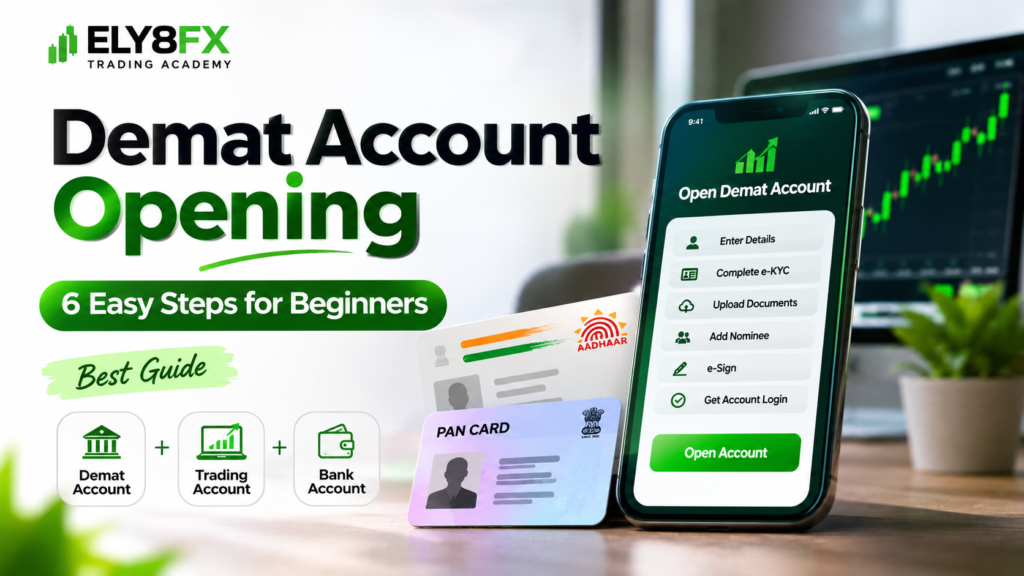
Demat Account Opening: 6 Easy Steps for Beginners, Best Guide

Demat account opening is the first practical step for anyone who wants to buy shares in India. Without a demat account, you cannot hold shares in electronic form, and without a trading account you cannot place orders. The good news is that demat account opening is now fully online and usually takes only a few days. In this guide, you will learn what a demat account is, which documents you need and six easy steps to complete it. What Is a Demat Account? A demat account (short for dematerialised account) holds your shares and other securities in electronic form, just like a bank account holds your money. Earlier, investors received paper share certificates. Now everything is stored digitally with a depository, and in India the two depositories are NSDL and CDSL. Your broker acts as a depository participant, which is the link between you and the depository. Demat Account vs Trading Account vs Bank Account Many beginners confuse these three accounts, so here is the simple difference. Your bank account holds your money. Your trading account is used to place buy and sell orders on the exchange. Your demat account stores the shares you buy. For smooth trading, all three should be linked, and most brokers offer demat account opening together with a trading account. Documents Needed for Demat Account Opening Keep these ready before you start: Make sure the name and details on your PAN, Aadhaar and bank account match. Small mismatches are the main reason for delays in demat account opening. Step 1: Choose a SEBI Registered Broker Pick a broker that is registered with SEBI, the market regulator. Never open an account with anyone who is not registered. Compare the account opening fee, yearly maintenance charge, brokerage, platform quality and customer support. The cheapest option is not always the best, so check the full list of charges before you decide. Step 2: Start the Online Application Visit the broker website or app and enter your mobile number, email and PAN. You will receive an OTP to verify both. Most brokers make this step very quick, and the whole demat account opening form takes about 10 to 15 minutes. Step 3: Complete e-KYC KYC means Know Your Customer. Most brokers use Aadhaar based e-KYC, where you verify yourself with an OTP sent to your Aadhaar linked mobile. You may also need to take a selfie or do a short video verification. This step confirms that you are a real person and the owner of the documents. Step 4: Add Bank Details and Upload Documents Link your bank account by entering the account number and IFSC code, or by using the small test deposit method. Then upload your photo, signature and any other documents asked. Keep the images clear, because blurry uploads are often rejected. Step 5: Add a Nominee and Sign Digitally Add a nominee so that your shares can pass to the right person in future. Follow the current nomination rules asked by your broker. After that, review all the details, accept the terms and sign the form digitally using an Aadhaar OTP (e-sign). Step 6: Wait for Verification and Login The broker verifies your application. Demat account opening is usually approved within one to three working days. You will then receive your client ID and login details by email or SMS. Add money to your trading account, and you are ready to place your first order. Demat Account Charges You Should Know Check these charges before you open the account: account opening fee, annual maintenance charge (AMC), brokerage per trade and depository charges when you sell shares. Some brokers charge nothing for opening, but others do, so always read the fee page. Ask whether a basic demat account with lower charges is available if you plan to hold only a few shares. Common Mistakes in Demat Account Opening The most common mistakes are choosing a broker without checking SEBI registration, giving a wrong mobile number, using a mobile number not linked to Aadhaar, mismatched names in documents and ignoring hidden charges. Never share your login password or OTP with anyone, even if they say they are from the broker. What to Do After Demat Account Opening Do not rush to trade with a large amount. Start small and learn first. Read our beginner guide on how to start share market to plan your first steps. Always protect your capital with a stop loss in trading, and follow the rules in our guide on risk management in trading. Practice on a demo account if your platform offers one. Frequently Asked Questions How long does demat account opening take?Usually one to three working days after you submit all documents, if the details match. Can I open a demat account without a PAN card?No. A PAN card is compulsory for demat account opening in India. Can I have more than one demat account?Yes, you can hold more than one, but each has its own charges, so most beginners start with one. Is demat account opening free?It depends on the broker. Some do not charge for opening, but yearly maintenance and other charges may apply. Is my money safe in a demat account?Your shares are held with a depository, but share prices can still fall. A demat account protects ownership records, not you from market risk. Conclusion Demat account opening is simple when you keep your documents ready, choose a SEBI registered broker and complete the e-KYC carefully. Compare the charges, check all details twice, and start with a small amount after the account is active. Learning matters more than rushing to trade. If you want to learn trading step by step with expert guidance, join ELY8FX, one of the best trading academy in Kerala options for beginners. Book your free demo class today. Disclaimer: Trading and investing involve risk, and you can lose money. This article is for educational purposes only and is not financial advice.

stop loss in trading
Risk Management

Stop Loss in Trading: 5 Best Ways to Set It, Easy Guide

Stop loss in trading is a simple order that closes your trade automatically when the price moves against you by a fixed amount. It is the most important safety tool for every trader, because it decides how much you can lose before you even enter a trade. In this guide, you will learn what stop loss in trading means, why it matters and five easy ways to set it correctly. What Is a Stop Loss in Trading? A stop loss in trading is an order you place with your broker to exit a trade at a price you choose in advance. For example, if you buy a share at 100 rupees and place a stop loss at 95 rupees, your trade closes automatically if the price falls to 95. Your loss is limited to 5 rupees per share, no matter how far the price falls after that. Why Stop Loss in Trading Matters Without a stop loss, one bad trade can wipe out weeks of profit. Stop loss in trading protects your capital, removes the need to watch the screen all day and stops emotions from making decisions for you. Many beginners hold a losing trade and hope that it will come back, and that hope is how small losses become huge ones. Types of Stop Loss There are two common types of stop loss in trading. A fixed stop loss stays at the price you set, and it only changes if you choose to change it. A trailing stop loss moves up with the price when your trade is in profit, which helps you lock in gains. Beginners should start with a fixed stop loss, because it is simple and easy to follow. Way 1: Place It Beyond Support or Resistance A good stop loss in trading is based on the chart, not on hope. For a buy trade, place the stop loss just below a clear support level. For a sell trade, place it just above resistance. If the price breaks that level, your trade idea is wrong and it is time to exit. Read our guide on support and resistance in trading to learn how to find these levels. Way 2: Use the Candle High or Low Candlestick patterns often show you the exact place for your stop. If you buy after a hammer, the low of the hammer candle is a logical stop loss. If you sell after a bearish engulfing candle, the high of that candle works well. You can learn these patterns in our beginner guide on candlestick patterns. Way 3: Use a Fixed Percentage A simple method is to risk a fixed percentage of the trade value, such as 2% or 3% below your entry price. This is easy for new traders, but it does not look at the chart. Use it only while you are learning, and move to chart-based levels as soon as you can. Way 4: Use Volatility (ATR) Some markets move more than others. The Average True Range (ATR) indicator shows how much a market usually moves. Many traders place the stop loss at 1.5 to 2 times the ATR from the entry. This keeps the stop outside the normal market noise, so you are not stopped out too early. Way 5: Decide It Before You Enter Always choose your stop loss before you click buy or sell. Then calculate your position size from it, so that the loss stays within 1% to 2% of your account. Our guide on risk management in trading shows the exact formula. Once the trade is live, never move your stop loss further away. Stop Loss and Position Size Example Suppose your account is 100,000 rupees and you risk 1%, which is 1,000 rupees. You buy a share at 200 rupees with a stop loss at 190 rupees, so your risk is 10 rupees per share. Your position size is 1,000 divided by 10, which is 100 shares. If the stop loss is hit, you lose about 1,000 rupees, as planned. Common Stop Loss Mistakes The most common stop loss in trading mistakes are trading without a stop loss, placing it too close so that normal movement stops you out, moving it further away after entering, removing it when the price gets near and risking too much on one trade. Another mistake is placing the stop loss at an obvious round number where many traders cluster. Add a small buffer instead. Frequently Asked Questions Is stop loss in trading compulsory?It is not forced by law for every trade, but every serious trader uses one. Without it, a single unexpected move can cause a very large loss. Where should I place my stop loss?Place it at a logical chart level, such as below support for a buy trade, and keep your total risk within 1% to 2% of your account. What is a trailing stop loss?It is a stop loss that moves in the direction of your profit as the price moves, so it helps protect gains while allowing the trade to run. Can a stop loss guarantee that I will not lose more than planned?Not always. In fast markets or after big news, the price can jump past your stop level, which is called slippage. A stop loss still limits most losses, but it is not a perfect guarantee. Conclusion Stop loss in trading is not about avoiding every loss. It is about keeping each loss small, so that you can stay in the market and keep learning. Choose your stop loss from the chart, set it before you enter, size your trade properly and never move it wider. If you are new to the market, start with our guide on how to start share market and practice on a demo account first. If you want to learn trading step by step with expert guidance, join ELY8FX, one of the best trading academy in Kerala options for beginners. Book your free demo class today. Disclaimer: Trading involves risk, and you can lose

How to start share market
Share Market Malayalam

How to Start Share Market: 7 Easy Steps, Best Guide

When you learn how to start share market trading, avoid these common mistakes: How to start share market is the first question almost every beginner in Kerala asks. The good news is that the process is simple: you need a few documents, a demat and trading account, and a basic plan to protect your money. In this guide, you will learn how to start share market investing and trading in seven easy steps, in simple language. What Is the Share Market? The share market (also called the stock market) is a place where shares of companies are bought and sold. When you buy a share, you own a small part of that company. In India, shares are traded mainly on two exchanges, the NSE and the BSE. Share prices go up and down depending on company performance, news and demand and supply.If you are wondering how to start share market investing, the next sections explain it step by step. How to start share market Investing vs Trading: What Is the Difference? Before you learn how to start share market activity, decide what you want. Investing means buying shares and holding them for a long time, usually years. Trading means buying and selling in a shorter time, from minutes to weeks, to profit from price movements.Your answer decides how to start share market activity in a way that suits your goals and risk level. Trading needs more skill, time and risk control. Most beginners should start by learning first and keeping the amount small. Step 1: Learn the Basics First Before putting money in, learn the basic terms: shares, demat account, buy and sell orders, market order and limit order, stop loss, and the difference between delivery and intraday trades. Reading guides like this one and attending a good course will save you from expensive beginner mistakes. Step 2: Keep the Required Documents Ready To open an account you normally need your PAN card, Aadhaar, a bank account linked to your mobile number, a passport size photo and a cancelled cheque or bank statement. Your PAN and Aadhaar details should match your bank records to avoid delays. Step 3: Open a Demat and Trading Account A demat account holds your shares in electronic form, like a bank account for shares. A trading account is used to place buy and sell orders. Most brokers give both together. Choose a broker registered with SEBI, the market regulator. You can check a broker’s registration on the official SEBI website. Compare brokerage charges, platform quality and customer support before you decide. Opening this account is the most important part of how to start share market trading in India. Step 4: Complete KYC and Link Your Bank KYC means Know Your Customer. Most brokers now do it online with an e-KYC process using your Aadhaar and a selfie or video verification. After this, link your bank account so you can add and withdraw money. Account opening usually takes a few days. Step 5: Start With a Small Amount When your account is ready, add only money that you can afford to lose. Do not borrow money or use your emergency savings to start share market trading. A small amount is enough to learn how real orders work and how it feels when the price moves against you. This small start is the safest way to practice how to start share market trading without big losses. Step 6: Practice Risk Management From Day One Every successful trader protects capital first. Risk only 1% to 2% of your account on one trade, and always use a stop loss. Read our detailed guide on risk management in trading to learn position sizing and risk-reward ratio. Step 7: Learn Chart Reading and Keep a Journal If you want to trade, learn to read charts. Start with our beginner guide on candlestick patterns, then learn support and resistance in trading to find better entry points. Write every trade in a journal with the reason, result and lesson. After a month, you will see which mistakes you repeat. Common Mistakes Beginners Make Following tips from random social media pages or Telegram groups, investing borrowed money, trading without a stop loss, putting all the money in one share, expecting quick profits and overtrading are the most common mistakes. Be very careful with anyone who promises guaranteed returns, because no one can guarantee profit in the share market. Frequently Asked Questions How much money do I need to start share market investing?There is no fixed minimum. You can begin with a small amount. Many beginners start with an amount they can afford to lose while they learn. Which is better for a beginner, investing or trading?Investing is generally simpler. Trading needs more learning and risk control. Whatever you choose, learn first and start small. Is the share market safe?Share prices can fall, and you can lose money. It is safer when you learn the basics, use a SEBI registered broker, diversify and manage risk. Can I learn the share market in Malayalam?Yes. Many academies and creators teach in Malayalam. Choose a source that explains risk honestly and does not promise guaranteed profits. Conclusion Now you know how to start share market investing and trading step by step: learn the basics, keep documents ready, open a demat account with a SEBI registered broker, complete KYC, start small, manage risk and keep learning. Practice patiently, because consistent learning matters more than quick profit. If you want to learn trading step by step with expert guidance, join ELY8FX, one of the best trading academy in Kerala options for beginners. Book your free demo class today. Disclaimer: Trading and investing involve risk, and you can lose money. This article is for educational purposes only and is not financial advice.

candlestick-patterns-malayalam
Candlestick Patterns

Candlestick Patterns for Beginners: A Simple Guide to Reading Charts

Candlestick patterns Malayalam guide for beginners: if you are new to trading, the first thing you notice on any chart is the candlestick. Each candle tells a small story about the battle between buyers and sellers. In this guide, Malayalam-speaking beginners in Kerala will learn how to read candles and spot the most popular patterns in simple language. What Is a Candlestick? A candlestick shows how the price of an asset moved during a fixed period, such as 1 minute, 1 hour or 1 day. Every candle has four data points: Open, High, Low and Close. If the price closes above where it opened, the candle is bullish (usually green). If the price closes below where it opened, the candle is bearish (usually red). Parts of a Candlestick The body is the thick part between the open and close prices. A big body shows strong buying or selling. The wicks (shadows) are the thin lines above and below the body. They show the highest and lowest prices reached during that period. Long wicks mean the price tried to move far but was pushed back, which is often an important clue.candlestick-patterns-malayalam Doji Pattern A doji forms when the open and close prices are almost the same, so the body is very small or looks like a thin line. It means buyers and sellers are balanced and the market is undecided. If a doji appears after a long uptrend or downtrend, it can warn that momentum is slowing. Do not trade a doji alone. Wait for the next candle to confirm the direction. This is one of the first candlestick patterns Malayalam-speaking beginners should learn.This is one of the first candlestick patterns Malayalam-speaking beginners should learn. Hammer Pattern A hammer has a small body at the top and a long lower wick, at least twice the size of the body. Sellers pushed the price down, but buyers returned strongly and pulled it back up. When a hammer appears at the end of a downtrend, it can signal a possible reversal upward. Many candlestick patterns Malayalam traders use for reversals, like the hammer, work best near support. Bullish Engulfing Pattern This pattern has two candles. A small red candle is followed by a larger green candle that completely covers (engulfs) the red one. It shows buyers have taken control, and it is more reliable when it forms near a support level after a downtrend. Bearish Engulfing Pattern This is the opposite. A small green candle is followed by a larger red candle that engulfs it. It shows sellers are taking control, and it is stronger near a resistance level after an uptrend. Shooting Star Pattern A shooting star has a small body at the bottom and a long upper wick. Buyers pushed the price up, but sellers rejected it and pulled it back down. After an uptrend, it can warn of a possible reversal downward. Morning Star Pattern The morning star is a three-candle pattern. First comes a large red candle, then a small-bodied candle (often a doji), and then a large green candle. It suggests a downtrend may be ending and buyers are returning. Support and Resistance with Candlesticks Candlestick patterns work best at key price levels. A hammer or bullish engulfing candle near a support level is more meaningful than the same candle in the middle of nowhere. In the same way, a shooting star or bearish engulfing candle near resistance is a stronger warning. Always mark support and resistance on your chart first, then look for candlestick patterns at those levels. How to Use Candlestick Patterns Correctly When using candlestick patterns, Malayalam-speaking traders should focus on learning a few patterns well instead of memorising dozens. Common Mistakes Beginners Make Learning candlestick patterns Malayalam beginners often make the same few mistakes, so avoid these. Trading every pattern they see, ignoring the trend, skipping the stop loss, using tiny timeframes and overtrading, and expecting guaranteed profits. Frequently Asked Questions Which candlestick pattern is most reliable?No single pattern is always reliable. Engulfing patterns and hammers near support or resistance levels, on higher timeframes, tend to give better signals. Can beginners trade using only candlestick patterns?It is not recommended. Combine candlesticks with trend, support and resistance, and risk management. Which timeframe is best for candlestick patterns?Higher timeframes like 1-hour, 4-hour and daily are generally more reliable than very short ones. Conclusion Learning candlestick patterns in Malayalam-friendly language makes trading easier to understand, but it takes regular practice. Remember that no pattern is perfect, so combine them with trend analysis and strong risk management. If you want to learn trading step by step with expert guidance, join ELY8FX, one of the best trading academy in Kerala options for beginners. Book your free demo class today.

Scroll to Top